
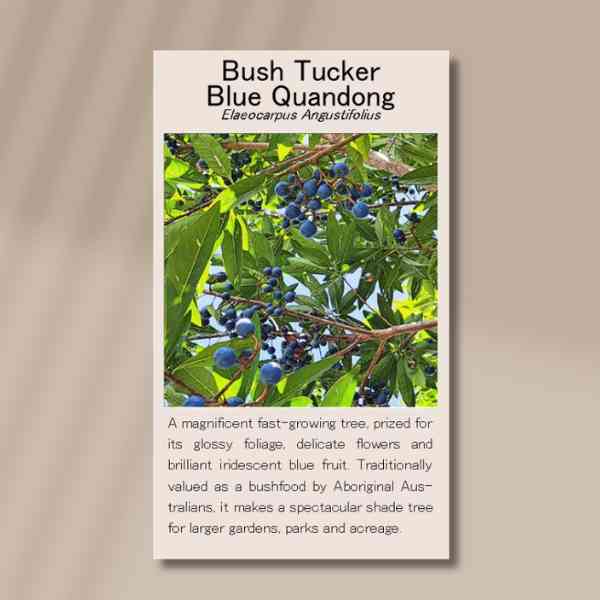


Blue Quandong
$9.99
Elaeocarpus Grandis
- Seed Count 3
- Conversation Starter
- Large Tree
- Height 10 – 30 m
In stock
Description
Blue Quandong -has a graceful structure and a canopy that feels lush without looking heavy. The foliage is glossy and deep green, clean and refined, and older leaves often colour beautifully before they fall, turning shades of crimson, bronze and red that glow against the green. It’s flowers are pale, creamy to greenish white, and carried in hanging clusters that move lightly among the leaves.
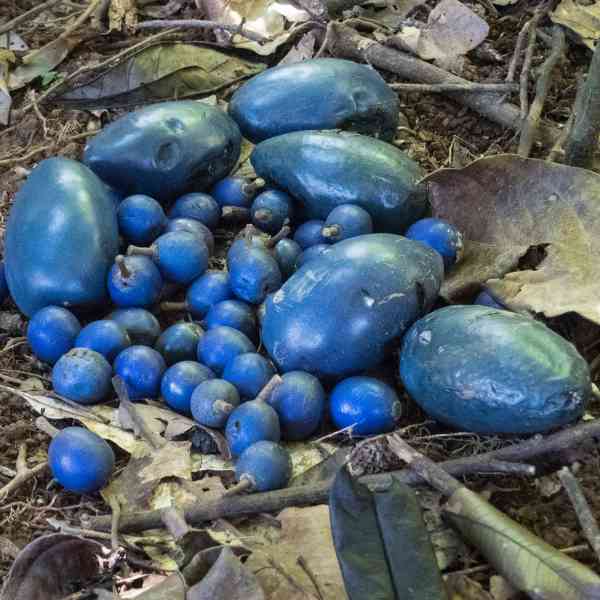
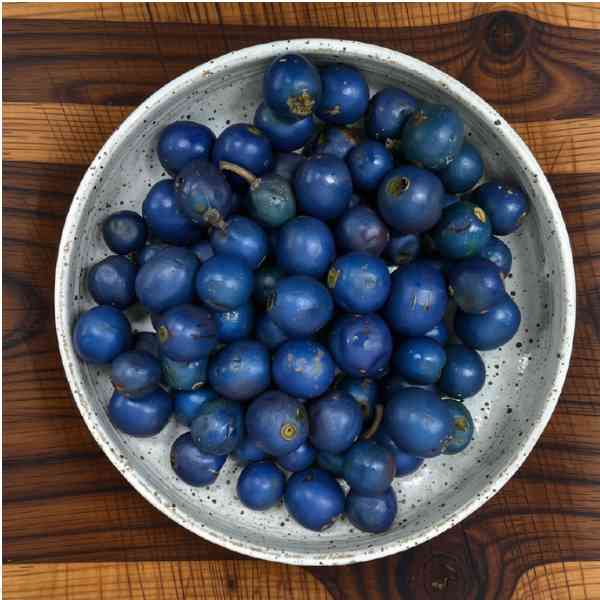
Then come the fruits, and this is where Blue Quandong becomes something truly special. The colour alone sets it apart. The fruits ripen to a remarkable electric blue to deep cobalt, a tone so intense it can seem almost artificial at first glance. In sunlight they can look glossy and jewel-like, scattered through the canopy or lying beneath the tree like polished beads.
Blue Quandong carries a bush food history, with a flavour that tends towards being tart, tangy, slightly bitter or astringent and works well in preserves, sauces, experimental kitchen use or native food applications, offering something far more individual than standard sweet fruit.
Inside the fruit sits one of the tree’s most distinctive features, the beautifully sculptured stone. They are hard, deeply grooved and richly textured, almost like something carved by hand. Once cleaned, they are striking objects in their own right and can be used in jewelry making or craft projects.
It is a wonderful tree for gardeners who appreciate plants with a bit of conversation around them. The fruits invite questions. The name invites questions. The beautifully wrinkled stones invite questions. Visitors notice it. Gardeners remember it. That has real value in a home garden, where a plant is often loved not just for performance but for the way it sparks interest and becomes part of the life of the place. Blue Quandong is the sort of tree people point out when it is fruiting, and the sort of tree that becomes more admired the longer it is known..
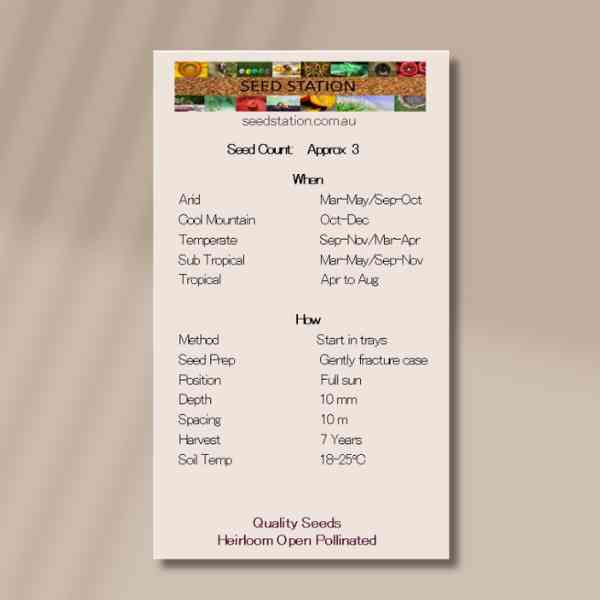
| Method: Start in trays | Soil Temp: 18°C - 35°C |
| Cool Mountain: Oct - Dec | Position: Full sun |
| Arid: Mar-May/Sep-Oct | Row Spacing: 10 m apart |
| Temperate: Sep-Nov/Mar-Apr | Planting Depth: 3mm |
| Sub Tropical: Mar-May/Sep-Nov | Harvest: 7 years |
| Tropical: Apr - Aug | Plant Height: 15 m |
Blue Quandong Grow Guide
🌱 Overview
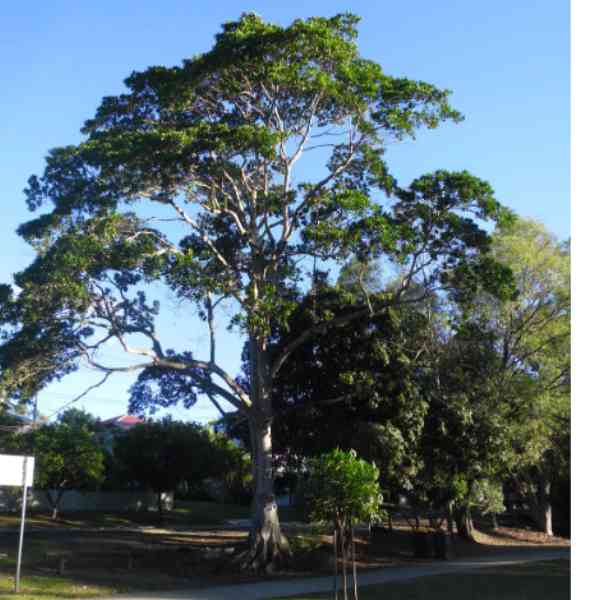
Blue quandong is a fast-growing rainforest tree valued for its glossy foliage, cream fringed flowers, vivid blue fruit, and strong wildlife appeal. It is best suited to larger gardens, food forests, revegetation projects, creek-line plantings, and spacious shelterbelt designs rather than small courtyards. Mature trees can become very large, and older specimens may develop strong surface roots, so they should be planted well away from pipes, paving, foundations, small garden beds, and narrow fence lines.
This is a tree for growers who enjoy patience at the seed stage but rapid growth after establishment. The seed can be slow and uneven to germinate, yet once seedlings are up and growing in warm, moist, fertile conditions, they can develop strongly.
🪴 Sowing in Trays Versus Direct Sowing
For blue quandong, sowing in trays, deep tubes, or individual pots is the best method. The seed is enclosed in a very hard stone and can take a long time to germinate, sometimes up to two years if left untreated. Raising the seed in a controlled container makes it easier to manage moisture, protect from rodents and insects, check progress, and prevent the seed from being lost among weeds or mulch.
Use a deep seedling tube or pot rather than a shallow punnet where possible. This gives the young root system room to develop and reduces stress when planting out. A tray can still be used, but individual deep cells are better because the seedlings can be moved on with less root disturbance.
Direct sowing is possible, but it is usually less reliable. The seed may sit in the ground for a long period, during which it can dry out, rot, be eaten, or be smothered by competing growth. Direct sowing only makes sense where you have plenty of seed, a protected site, consistent moisture, and low weed pressure. For most home growers, container sowing first, then planting out while the seedling is still young and vigorous, is the stronger choice.
🧪 Seed Pre-Treatment
Pre-treatment is strongly recommended. Blue quandong seed has a very hard outer stone, which slows water entry and delays germination. Without treatment, germination can be very slow and irregular.
The best practical approach is to first remove all fruit flesh from the stone. Soaking the fruit or cleaned stones in water can help soften remaining pulp so it can be scrubbed away. After cleaning, the hard stone can be carefully cracked or weakened before sowing. Some growers crack the stone and sow it without removing the inner kernels, while others carefully remove the kernels and sow them directly. Both approaches require care because crushing the inner seed will ruin it.
A safe home method is to soak the cleaned stone, then use a nutcracker, vice, or firm pliers to gently fracture the hard casing without pulverising it. Sow the cracked stone immediately into a free-draining seed mix. Keep the mix moist but never waterlogged. Label the pot clearly, because germination may be slow.
🌤️ Soil and Position
Blue quandong prefers a moist, fertile, well-drained soil with plenty of organic matter. It naturally performs best in rainforest-style conditions where the root zone remains cool and protected, but it still needs drainage. Heavy clay can be improved with compost, aged leaf mould, coarse organic matter, and surface mulch, but avoid creating a soggy planting hole that holds water like a bucket.
Choose a position with full sun to part shade. Young plants appreciate protection from harsh exposure, drying winds, and reflected heat. Once established, the tree becomes more resilient, but it will still perform best where moisture is reasonably consistent.
Because this tree can become large, position is critical. Give it generous space from buildings, drains, paving, retaining walls, and small ornamental beds. It is better treated as a feature canopy tree, shade tree, habitat tree, or food forest overstorey than as a compact backyard fruit tree. (Tucker Bush)
💧 Care and Maintenance
The most important care task is consistent moisture during establishment. Keep young plants evenly watered, especially through dry spells, but avoid keeping the soil saturated. A thick organic mulch helps conserve moisture, suppress weeds, and protect surface roots. Keep mulch pulled back from the trunk to prevent collar rot.
Feed lightly with compost, worm castings, or a gentle organic fertiliser once the seedling is actively growing. Avoid heavy feeding while the plant is tiny, especially in pots, because excess fertiliser can damage young roots. In the ground, a broad mulch ring and gradual soil improvement are usually better than strong fertiliser.
Pruning should be minimal. Remove damaged, crossing, or poorly placed branches while the tree is young. Avoid hard pruning unless necessary, because the tree naturally wants to form a tall canopy. If grown in a food forest or revegetation setting, let it develop its natural shape and focus on keeping weeds and grass away from the root zone.
🌿 Companion Planting Guide
Blue quandong works best with companions that enjoy moisture, mulch, shelter, and dappled light. Since it can become a large canopy tree, companion planting should be planned in layers.
Good companions include native ginger, lomandra, dianella, native violet, midyim berry, lemon myrtle, native raspberry, Davidson plum, native gardenia, and rainforest shrubs that appreciate similar soil moisture. These plants help create a living mulch, attract insects, stabilise the soil, and build a sheltered microclimate.
Avoid planting it too close to small sun-loving herbs, vegetables, or shallow-rooted plants that dislike shade and root competition. Also avoid placing it beside plants that need dry, lean, open conditions. Blue quandong is better in a lush planting system than a dry Mediterranean-style bed.
A useful design is to plant blue quandong as the upper canopy, with moisture-loving shrubs beneath, strappy plants around the outer root zone, and soft groundcovers at the edge of the mulch ring. This reduces weeds while still allowing airflow around the trunk.
🫐 How to Harvest
Harvest fruit when it has turned a strong, bright blue and either drops naturally or releases easily from the tree. The thin flesh around the stone is edible but can be sour or slightly bitter. It may be eaten fresh in small amounts or processed into sauces, pastes, preserves, or blended preparations.
Collect fruit from clean ground or directly from the tree where possible. Avoid damaged, mouldy, fermented, or insect-infested fruit if saving seed. For eating, separate the flesh from the hard stone and process promptly, as soft fruit can deteriorate quickly.
⚠️ Common Issues and Fixes
| Issue | Likely Cause | Fix |
|---|---|---|
| Seed does not germinate | Hard stone has not been cracked or weakened, or germination is naturally slow | Clean the seed well, soak, carefully crack the stone, sow in a moist free-draining mix, and keep the pot labelled for long-term monitoring |
| Seed rots before sprouting | Mix is too wet, poorly drained, or fruit flesh was left on the stone | Remove all pulp before sowing, use a free-draining seed mix, and keep moist rather than soaked |
| Seedling collapses | Damping-off disease from stale air, overwatering, or contaminated mix | Use clean pots and fresh mix, improve airflow, water less often, and avoid overcrowding |
| Yellow leaves | Poor drainage, nutrient imbalance, or root stress | Check drainage first, reduce watering if soil is wet, apply compost lightly, and avoid strong fertiliser on young plants |
| Brown leaf edges | Dry wind, heat stress, or inconsistent watering | Provide temporary shade, mulch well, and water deeply during dry periods |
| Slow growth in pots | Pot is too small or roots are restricted | Move into a deeper container before the plant becomes root-bound |
| Poor growth after planting out | Competition from grass or weeds | Clear a wide ring around the plant, mulch deeply, and maintain regular watering while it establishes |
| Root or paving problems later | Tree planted too close to structures | Plant only where there is generous long-term space, away from drains, paving, walls, and buildings |
| Few flowers or fruit | Tree is young, stressed, shaded too heavily, or growing outside ideal moisture conditions | Improve water consistency, mulch, reduce competition, and allow the tree to mature |
🌰 Detailed Seed Saving Guide
For seed saving, choose fully coloured blue fruit from a healthy, vigorous tree. The best fruit for seed is mature, undamaged, and free from mould or insect holes. Fruit that has just fallen can be useful if it is fresh and clean, but avoid old fruit that has started to ferment or break down.
Remove the flesh from the hard stone as soon as practical. Soaking the fruit in water can make cleaning easier. Rub the softened flesh away by hand, with a cloth, or against a coarse sieve. The goal is to remove all pulp because leftover flesh can encourage mould during storage or sowing.
Rinse the cleaned stones thoroughly, then spread them in a shaded, airy place until the surface is dry. Do not bake them in strong heat. Once dry, inspect them and discard any that are cracked in the wrong place, hollow, soft, mouldy, or insect-damaged.
For best results, sow fresh cleaned seed rather than storing it for a long period. If storage is necessary, keep the cleaned stones in a breathable paper bag or labelled envelope in a cool, dry, dark place. Write the plant name, collection location, and collection date on the label. Because germination can be slow, careful labelling prevents pots from being accidentally discarded.
Before sowing saved seed, soak the stones and carefully crack or weaken the outer casing. Sow into a deep pot or tube filled with free-draining seed mix. Cover lightly, water gently, and keep in a warm, sheltered position with steady moisture. Do not keep digging the seed up to check it, as this can damage emerging roots. Patience is essential with blue quandong.
Once seedlings emerge, give them bright filtered light, gentle airflow, and even moisture. Move each seedling into a deeper pot if needed, handling the root system carefully. Plant out while young and healthy, before the roots become badly restricted.
🌳 Final Thoughts
Blue quandong is not a quick, compact, or low-space tree, but it is a rewarding choice for growers with room to let it become what it naturally wants to be. The main challenge is the seed: it needs cleaning, careful pre-treatment, and patience. Once established, the tree can grow strongly and become a beautiful canopy plant that offers shade, flowers, fruit, habitat, and a lush rainforest feel.
For the best results, raise the seed in deep containers, pre-treat the hard stone, keep the mix moist but free-draining, plant into a spacious position, and protect the young tree while it establishes. With the right site and care, blue quandong can become a long-lived feature in a generous garden or food forest.
Postage Charge
Orders under $35 attract a $4.95 shipping charge. Orders $35 and above have free shipping.
Order Times
Seed orders are normally dispatched within three business days. You will receive an email when seeds are mailed out.
Postage Days
Seeds are mailed out Tuesday to Friday at 1pm. Except for the Friday of long weekends.
Postage Times
WA 2-3 Days: SA,NT 3-5 Days: NSW, ACT, QLD, VIC: 5-7 Days
Carrier
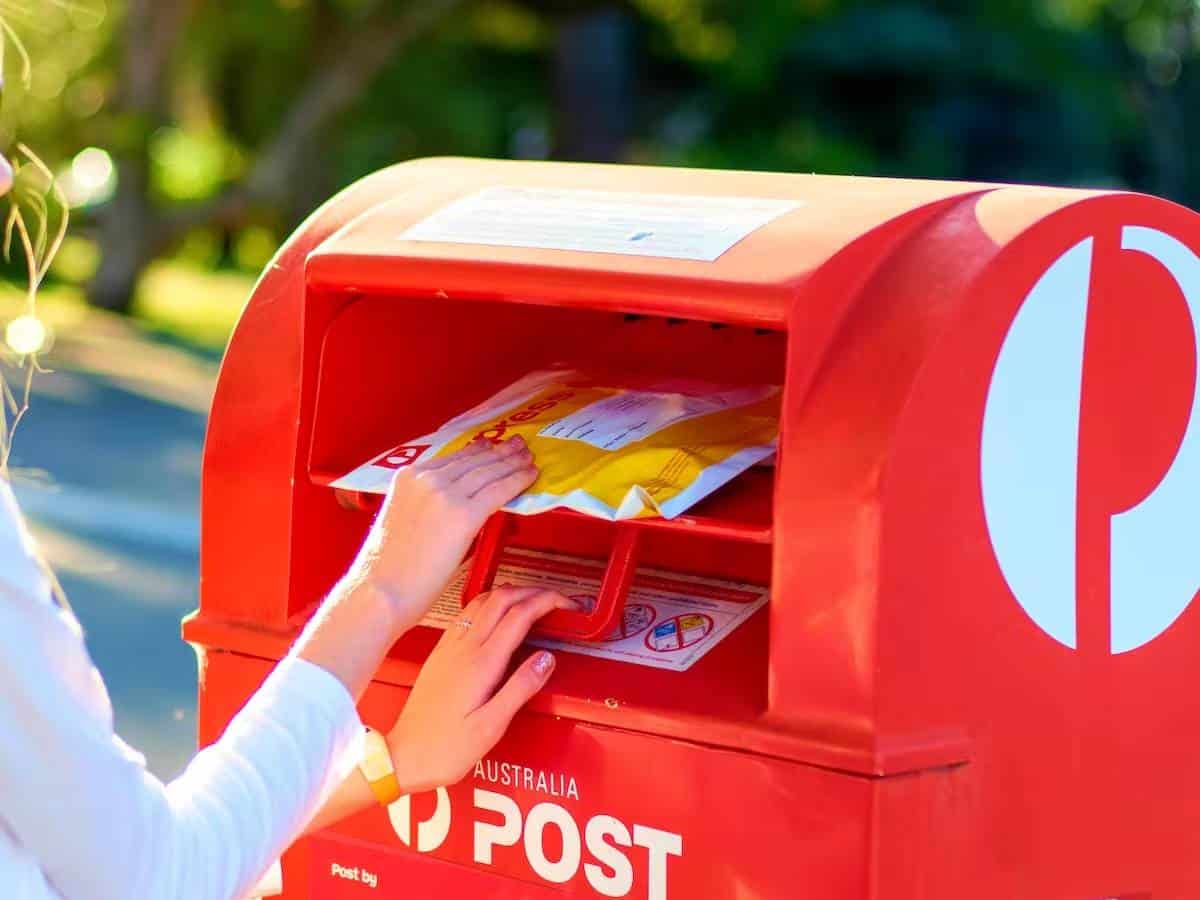
We use Australia Post Letter Postage for the majority of orders
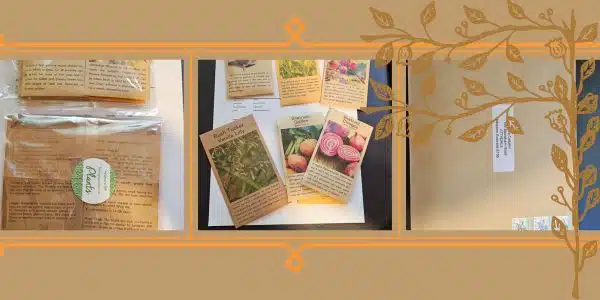
Not only are our seeds packed in recycled paper envelopes, we keep the theme going when we post out website orders. To protect your seeds from moisture and the letter box munchers (snails), we use a very special plastic free material made from plants. They are then put into recycled mailing envelopes. Green all the way ????????
Delivery Guarantee
We take great care to make sure your seeds arrive safely. If your order is lost or damaged in transit, we’ll happily send a replacement. Unfortunately, we can’t replace or refund orders that arrive later than the estimated delivery date, as delays can sometimes occur that are outside our control.
Please note that all dispatch and delivery times listed are estimates only. While we do our best to post promptly, delivery timeframes can vary due to postal service delays, weather events, or other unforeseen circumstances. We’re unable to take responsibility for any loss, damage, or cost that results from a late delivery.
An order is not considered missing until at least 20 business days have passed from the postage date. You’ll receive an email once your seeds have been posted, letting you know they’re on their way. If you don’t see it in your main inbox, please check your Spam or Promotions folders as sometimes our emails like to hide there.

Reviews
There are no reviews yet